AMC-14 to Lift Off on Friday Night
Sebadoh – Thu, 2008 – 03 – 13 12:19


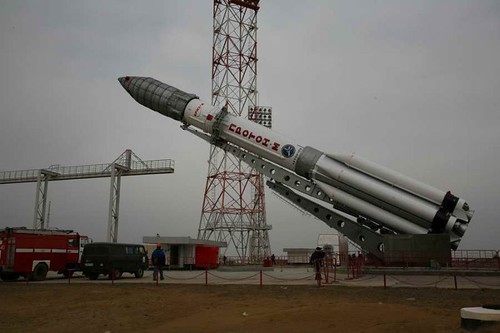
SES-AMERICOM's AMC-14 launches from Baikonur Cosmodrome in Kazakhstan aboard a Proton M rocket on Friday night.

Local time for the launch is 5:18 a.m. on Saturday 15 March 2008 -- or 23:18 GMT on Friday the 14th of March.

What that means is you can watch the launch live in the United States -- but if you're on the East Coast, you may wish to start feeding the kids at 6 o'clock.

The live webstream will be available here, or watch on on C-band: AMC-1, transponder C17, 4040 Horiz., NTSC, analog, in the clear or on DISH channel 101.

The last update from the launch blog (on March 11) tells us:

The roll-out of the fully assembled Proton Breeze M launcher, carrying the AMC -14 spacecraft, to Launch Pad 39 commenced early in this morning (at 6:30 a.m. Baikonur time). By 10 a.m. the rocket was erected in vertical position. Once installed onto the pad, the Proton was enclosed inside a mobile service tower.
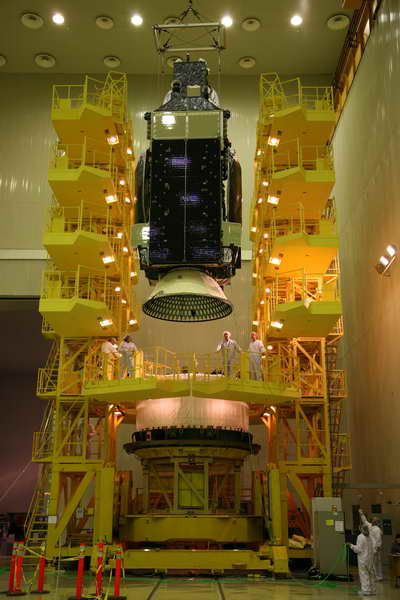


AMC-14 was originally part of a grand plan for direct-to-home services. 8.2 KW of power, the spacecraft has an active phased array (APA) payload consisting of a receive mode APA antenna, and the highest levels of redundancy on core components such as amplifiers, receivers, commanding beam and computer control systems. This means coverage can be reshaped while in orbit.

Developed primarily by Lockheed Martin Commercial Space Systems, the APA will be a key satellite technology for future missions.

From the get-go, AMC-14 will provide AMERICOM2Home® services in the United States for EchoStar Communications' DISH Network.


Score: 9.0, votes: 1

Comments

U.S. orbital arc

The FCC granted the STA yesterday. According to the document, in-orbit testing will be at 56.6° West, and the spacecraft will operate in the 61.5° West orbital location.

More HDTV? That's where Echostar 12/Rainbow-1 is broadcasting the Voom HD channels

Rocco Fanucci – Thu, 2008 – 03 – 13 20:51

About AMC-14

More about the spacecraft, AMC-14:


Rocco Fanucci – Fri, 2008 – 03 – 14 16:19

Proton Launch OK

Here's the launch video, courtesy of ILS:

Rocco Fanucci – Fri, 2008 – 03 – 14 21:17

61.5° West

No, this is not a replacement. Echostar 12/Rainbow-1 uses spot beams and half the alotted frequencies at 61.5° West. This ought to use what's left.

Rocco Fanucci – Fri, 2008 – 03 – 14 22:33

Bummer: 2nd stage

ILS declares anomaly:

Khrunichev and International Launch Services regret to announce an anomaly during today's Proton mission with the AMC-14 satellite.

The Proton Breeze M rocket lifted off at 5:18 a.m. today local time from the Baikonur Cosmodrome, carrying the AMC-14 satellite for SES AMERICOM and its customer, EchoStar Corporation.   Preliminary flight information indicates that the anomaly occurred during the second burn of the Breeze M upper stage. The satellite failed to reach the planned orbit.

Rocco Fanucci – Fri, 2008 – 03 – 14 23:17

News from Russian Space Agency

15 марта в 2 часа 18 минут 55 секунд по московскому времени с космодрома Байконур был осуществлен коммерческий пуск ракеты космического назначения «Протон-М» (производства ГКНПЦ им. М.В.Хруничева) с американским телекоммуникационным космическим аппаратом «АМС-14».

В 2 часа 28 минут 41 секунду (мск) космическая головная часть в составе разгонного блока «Бриз-М» и космического аппарата АМС-14 успешно отделилась от третьей ступени РН «Протон-М» и продолжила автономный полет по суборбитальной траектории. Все ступени ракеты-носителя упали в заданных районах. Таким образом, ракета-носитель отработала в штатном режиме.


Первое включение разгонного блока произошло штатно. В результате головной блок был выведен на опорную орбиту с параметрами, близкими к расчетным. При втором включении разгонный блок «Бриз-М», отработав 32 минуты, выключился раньше установленного срока на 2 минуты 13 секунд.


Космический аппарат «АМС-14» отделился от разгонного блока, управляем, но находится на орбите с параметрами 28 тысяч километров (вместо требуемых (расчетных) 36 тысяч км. Дальнейшее решение по нему будет принято заказчиком – американской корпорацией «SES AMERICOM, Inc” (США). Формируется межведомственная комиссия по анализу причин преждевременного выключения двигателя разгонного блока.

Rocco Fanucci – Sat, 2008 – 03 – 15 09:26

Russian: Translated

Basically says what ILS released earlier: on March 15th, at 02:18:55 Moscow time, a rocket launched from Baikonur with AMC-14 on-board. The Proton went through its three stage successfully, and the pieces of the rocket booster fell to earth where they were supposed to. The launch was within spec. When it got to the Briz-M block, is shut down 2 minutes and 13 seconds early. Further details will come from SES AMERICOM. A failure review board is being formed.

No need to do a word-for-word translation, right?

As to what's next, that up to Lockheed Martin and SES AMERICOM to decide. The spacecraft is apparently in a safe orbit and various scenarios/plans are being evaluated.


Rocco Fanucci – Sun, 2008 – 03 – 16 21:32

GTO and Fuel

Via SES:

SES AMERICOM, an SES company (Paris:SESG) (LuxX:SESG), today confirmed that its AMC-14 satellite failed to reach its intended orbit following its launch on board a Russian Proton Breeze-M launch vehicle on March 15. An anomaly during the second burn of the fourth stage of the rocket resulted in the satellite being placed short of the planned geostationary transfer orbit.
 
"While we are not in a position to comment on the possible causes of this launch anomaly, the satellite is healthy and is operating nominally in a stable orbit under the control of Lockheed Martin. SES and Lockheed Martin engineers are currently exploring various options for bringing AMC-14 into its proper geostationary orbit," said Martin Halliwell, President of SES ENGINEERING.

AMC-14 was built by Lockheed Martin Commercial Space Systems, with launch services from the Baikonur Cosmodrome in Kazakhstan provided by ILS (International Launch Services).

In all of the various scenarios to redirect the spacecraft, onboard fuel will have to be used to propel the satellite to its correct orbital position, thereby reducing its service life. SES’ investment in AMC-14 is insured for partial and total loss.

The spacecraft is entirely contracted by EchoStar Corporation and is intended to operate at the orbital position of 61.5 degrees West.

"We are confident that the engineering teams at Lockheed Martin and SES will find a way to place AMC-14 into the correct orbit in a manner that our customer’s requirements can be met," said Edward Horowitz, President and CEO of SES AMERICOM. "We cannot, at this time, speculate on the impact of the orbit raising activities on both the in-service date and the service life of AMC-14. We will provide additional information in due time."

Rocco Fanucci – Mon, 2008 – 03 – 17 10:19

SEC filing

Both companies (DISH and SATS) filed their Form 8-K with the SEC this morning, prompting an interesting discussion on SatelliteGuys.us:

DISH 8-K
 
 
On Friday, March 14, 2008, a Proton launch vehicle carrying the SES Americom AMC-14 satellite experienced an anomaly, which left the satellite in a lower orbit than planned.  While further testing will be necessary, the satellite currently appears to be functional, and engineers from SES Americom and Lockheed Martin, the manufacturer of the satellite, are currently exploring options to potentially bring AMC-14 into its proper orbit.  If the satellite can be brought into its proper orbit, its service life would be substantially reduced because onboard fuel would have to be used to correct its orbit.
 
We had expected to lease the entire capacity of the satellite from EchoStar Corporation in order to, among other things, increase the number of high definition channels we offer.  Therefore, the launch anomaly will result in a delay in our roll out of some high definition channels, including some local network channels.

SATS 8-K
 
On Friday, March 14, 2008, a Proton launch vehicle carrying the SES Americom AMC-14 satellite experienced an anomaly, which left the satellite in a lower orbit than planned.  While further testing will be necessary, the satellite currently appears to be functional, and engineers from SES Americom and Lockheed Martin, the manufacturer of the satellite, are currently exploring options to potentially bring AMC-14 into its proper orbit.  If the satellite can be brought into its proper orbit, its service life would be substantially reduced because onboard fuel would have to be used to correct its orbit.
 
We are not obligated to make any lease payments unless the satellite is successfully placed into commercial operation.  We had also made up front payments in excess of $40 million dollars with respect to the satellite.  We procured insurance covering substantially all of those up front payments.
 
We had intended to lease substantially all of the capacity of the satellite to DISH Network Corporation.  That revenue opportunity would be lost if the satellite cannot be placed into commercial operation.

Rocco Fanucci – Mon, 2008 – 03 – 17 12:34

Tracking AMC-14 on the Web

Using NORAD data and Google Maps, here's a site to help you track AMC-14's progress. The data are probably off by a day or two, but still pretty cool. Go AJAX.

Regarding the spacecraft's progress, here's the scoop from Inside Satellite TV (subscription):

Technicians are seemingly breathing a little easier over last weekend s lost Americom AMC-14 satellite.

While the consensus seems to be that they are not out of the woods just yet, the word from satellite operator SES, and its client Echostar, is that confidence is high and that AMC-14 can fulfil at least a good portion of its HDTV mission for the Dish Network.

Echostar, in a statement, says plans to expand their HDTV offering to subscribers remain on track despite the launch problems for the satellite. Dish Network customers can be reassured that the expansion of our HD programming over the next few months will proceed as planned,  Dish Network boss Charlie Ergen said in a statement.  We are fortunate to have two more satellites scheduled for launch later this year to continue our HD rollout and reach our year-end goal of 100 local HD markets and 100 national HD channels.

Echostar EVP Jim DeFranco, in a video conference with retailers late Tuesday night, said the company s HD video position was full steam ahead  and that he was optimistic the delayed satellite would get to its correct position. Echostar s Dish Network remains committed to adding new HD channels next month (April).

The official word is that engineers from SES Americom and Lockheed Martin are exploring options to bring the satellite into proper orbit, which could include firing its on-board rockets. The end result would be a shortened life-span for the satellite, but at least a happier client in the meantime.

But there's another element which must be factored in to the equation what the insurers want to do, although few suggest that they would want to de-orbit a craft that could well provide three or more years of operational life.

Rocco Fanucci – Thu, 2008 – 03 – 20 08:17

Complex Insurance

Generally, a consortium of insurance companies, and their re-insurers, combine to underwrite both the launch and in-orbit operation of a spacecraft.

The arrangement can be fairly complex and I don't know who is leading, brokering or re-insuring this deal. All parties with stakes in this launch (SES, Lockheed Martin, Echostar and ILS) probably have their own insurance, too. Some or all are insured for both partial and total loss of the spacecraft.

Who the insurance underwriters are is unclear.

Rocco Fanucci – Wed, 2008 – 04 – 02 10:47

AMC-14 = Total Loss

SES told their insurers not much can be done with this spacecraft:

“SES and Lockheed Martin have carefully examined all the available options for repositioning this satellite into its intended geostationary orbit,” said Edward Horowitz, President and CEO of SES AMERICOM. “Unfortunately, none of those options would allow effective use of the spacecraft. The various repositioning scenarios presented carry unacceptable risks, and would result in a severely shortened life of the satellite. Therefore, we have no choice but to claim a total loss of the satellite with our insurers.”

AMC-14 was built by Lockheed Martin Commercial Space Systems, and launched on a Proton/Breeze M rocket provided by ILS (International Launch Services) from the Baikonur Cosmodrome in Kazakhstan.

The launch of AMC-14 failed on March 15 when an anomaly during the second burn of the fourth stage of the rocket resulted in the satellite being placed short of the planned geostationary transfer orbit. While an initial assessment of the available options to reposition the satellite appeared encouraging, more detailed examinations by SES and Lockheed Martin engineers determined that the various scenarios could not provide a reasonable chance of success.

Mark Rigolle, Chief Financial Officer of SES commented: “The loss of any satellite is a disappointment, and the failure of AMC-14 means there will be no revenues to come from this programme. However, SES is fully insured for its investment, and there will be no negative P&L impact from the accelerated writedown of AMC-14. We expect to receive the insurance proceeds of approximately USD 150 million in the next few months, thereby enhancing our cash position. The rest of our business in North America and worldwide has no connection with, and is unaffected by, this launch failure.”

While AMC-14 is currently in a stable orbit, SES is exploring plans to retire the satellite.

DISH Network customers were hoping there was some way to bring AMC-14 into service. Raising the orbit using on-board fuel was probably going to cost too much, shortening its service life substantially. Using the Moon's gravity to slingshot the bird back to Earth was another risky option. Now Space Daily has learned this "lunar gravity assist" method is a patented process claimed by Boeing:

Attempts to salvage a wayward GEO comsat have come unstuck in the face of institutional disinterest and an aging patent of questionable validity.

The AMC-14 commercial geostationary satellite was launched in March by a Proton launch vehicle into space just short of its minimum geostationary transfer orbit (GTO).

SES Americom, the world's largest commercial satellite firm, owns the satellite and was to lease capacity on AMC-14 to the Echostar group.

Following the failed launch, SES Americom looked into how they might salvage the satellite in a manner similar to the Asiasat-3 salvage in 1998.

However, SpaceDaily has now learned that a plan to salvage AMC-14 was abandoned a week ago when SES gave up in the face of patent issues relating to the lunar flyby process used to bring wayward GEO birds back to GEO Earth orbit.

Sources have told SpaceDaily that it was possible to bring AMC-14 back via the moon to a stable GEO orbit where the high powered satellite would have been able to operate for at four years and probably longer.

In the face of unrelated legal battles between the current patent owner Boeing and the satellite's owner SES Americom - any efforts to salvage AMC-14 have been cast aside.

Primarily this is because SES is currently suing Boeing for an unrelated New Skies matter in the order of $50 million dollars - and Boeing told SES that the patent was only available if SES Americom dropped the lawsuit.

Industry sources have told SpaceDaily that the patent is regarded as legal "trite", as basic physics has been rebranded as a "process", and that the patent wouldn't stand up to any significant level of court scrutiny and was only registered at the time as "the patent office was incompetent when it came to space matters".

SES has decided not to pursue any legal options against Boeing and wants to collect their insurance policy payout. However, their insurance company was not being fully briefed on the options and at this time is planning to pay the policy out.

Separately, another company has approached the insurers about buying the spacecraft for salvage using the lunar flyby option. Initially, the insurers were surprised as they had no knowledge of this option and suggested that they contact SES Americom directly.

While most satellite insurance policies allow the insurer to take ownership of a satellite when they pay a claim, they rarely do this. The default is instead to leave "ownership" with the operators, who are then legally obliged to safely deorbit the satellite or move the satellite into a GEO parking orbit.

At this stage SES Americom is working with a major US space consultancy to rapidly deorbit the satellite - as early as this Friday. SpaceDaily has been told that various attempts by third parties to buy the satellite have been ignored and both parties are "eager to splash the satellite within days".

Rocco Fanucci – Fri, 2008 – 04 – 11 06:02

All your physics are mine

Excellent comments on Boing Boing, solidly on-topic -- especially this one by Simon Bradshaw:

Wow. As someone with both a Master's degree in satcom engineering (which included a good sized lump of orbital mechanics) and most of another Master's degree in IP Law, I feel unusually qualified to comment on this.

Even by the barrel-scraping standards of the US Patent Office, this is what we English legal types refer to technically as "utter bollocks".

Where's the inventive step? Where is the idea not obvious to a skilled practitioner in the field? Whilst as a good European I object to patents on scientific and mathematical methods, I can at least concede that some of the orbit-related patents that have been granted on, say, use of weird chaotic transitions through the Lagrange points are at novel and inventive. But use of a swingby to simultaneously change the eccentricity and inclination of an orbit is out of Orbits 101; it was done in 1992 at Jupiter for the Ulysses mission, and space journalist James Oberg described how it could be done to get into geostationary orbit in an article back in 1984. There's abundant prior art to invalidate this patent, even leaving aside the matter that it should never have been patentable in the first place.


Rocco Fanucci – Fri, 2008 – 04 – 11 08:47

Gas Duct Rupture

That was quick, via SpaceflightNow.com:

The Russian State Commission investigating the AMC-14 failure of a Proton Breeze M launch has traced the cause to the rupture of the gas duct between the gas generator and the propellant pump turbine in the Breeze M main engine.

This led to the Breeze M upper stage engine shutting down 2 minutes before the end of the second Breeze M burn on March 15. As a precaution, the AMC-14 satellite payload was released into a lower-than-planned orbit. Owner SES AMERICOM announced that it is declaring AMC-14 a total loss. The mission was managed by International Launch Services (ILS), which markets commercial missions on the Proton vehicle.

The Russian investigative commission said that the most probable cause of the gas duct rupture was due to the combined effects of duct wall erosion, high temperatures and prolonged low frequency pressure fluctuation in the duct. The Commission recommended corrective actions to comprehensively address each of the contributing factors. Khrunichev, which manufactures both the Proton 3-stage booster and the Breeze M upper stage, was further directed to perform corrective action to improve the reliability of the Breeze M main engine. These corrective actions must be taken before the Breeze M can be returned to flight, according to Russian procedure.

Rocco Fanucci – Mon, 2008 – 04 – 21 22:33

For Sale: BSS Ku-band. Never used.

Reminds me of a brilliant Ernest Hemingway short story he was purported to have submitted to a literary magazine, after repeated requests from the editor.  Hemingway wasn't interested, so he sent this: "For sale: wedding dress; never used."

That's what I call a short story.

Thought the AMC-14 story was over. Do we see another scoop by Space Daily? Funny, no mention of the spacecraft being exposed to an inordinate amount of radiation since launch:

Sources have told SpaceDaily that a US Department of Defense agency is negotiating to buy the AMC-14 satellite from SES directly with a loss adjustment then to be paid out by the underwriters. The US government would then move AMC-14 to a geostationary orbit inclined at roughly 10 degrees to the equator.

Sources warned "the government is being had. SES is selling them an inferior mission. SES is purposefully downplaying the other options to protect themselves."

As reported earlier in SpaceDaily SES is reluctant to pursue a rescue that uses a Lunar flyby due to a legal dispute with Boeing involving several issues including a patent that lays claim to the lunar flyby process.

At the same time, there are other issues with such a purchase.

A government purchase and use of this spacecraft may be a violation of the Commercial Space Act of 1998, which prohibits US government agencies from owning spacecraft to produce products they can buy commercially.

"Any capability available on AMC-14 can be purchased commercially. If the government needs this sort of service, they must buy it from commercial providers as the 1998 Commercial Space Act requires." an industry expert requesting anonymity told SpaceDaily.

Meanwhile, the lunar flyby rescue option continues to be dismissed by SES to their potential government customer and to the underwriters.

"The last thing they want is for that option to be proven out. They told the underwriters that only an inclined orbital profile was available. It would look bad if someone were to salvage the spacecraft and perform the lunar transfer mission."

While the underwriters may have been misled, they are more worried about offending SES than they are about paying out. SES is the biggest player in the GEO market and an endless source of rich insurance premiums.

Further complicating the situation is the entry of several other commercial entities that are negotiating with the underwriters to buy the satellite and then use the lunar flyby process to recover the satellite into GEO.

Despite claims by SES that "the numbers didn't work" for even a two to three year mission lifetime, experts have mapped out a mission profile similar to the 1998 HGS-1 trajectory that produces more than five years of operational lifetime in a GEO orbit.

Of critical concern for SES at this stage is preventing negotiations between the underwriters and these other entities from coming to fruition. SES would like to both get the payoff from the underwriters and to prevent the spacecraft from ending up in the hands of competitors.

"They would specifically like to prevent the vehicle from being bought by Echostar, the customer that originally intended to lease AMC-14 from SES," sources told SpaceDaily.

Rocco Fanucci – Wed, 2008 – 04 – 23 09:06

U.S. Govt: We'll Take It

Via Space News:

The AMC-14 commercial telecommunications satellite that was placed into the wrong orbit in March following a Proton rocket failure has been sold to the U.S. Defense Department for about $15 million by insurance underwriters, who took title to the spacecraft following a settlement with satellite fleet operator SES of Luxembourg, industry officials said.

One industry official familiar with the insurance sale to the Pentagon said it was conditioned on a guarantee by U.S. defense authorities that the satellite would not be purposely destroyed in orbit.

While there was no indication that U.S. defense authorities intended to do such a thing, this official said the companies involved in the sale wanted to protect themselves against any future allegations that they had contributed to orbital debris.

The demand that the transfer of title to the satellite include a no-shootdown clause illustrates the nervousness of satellite underwriters and fleet operators in the wake of two events: the Chinese anti-satellite missile test in January 2007, in which China destroyed one of its retired weather satellites; and the U.S. Defense Department's destruction of an out-of-control spy satellite in February using a sea-based missile.

SES officials made a brief reference to the AMC-14 sale during June 3-4 investor presentations in London and New York, saying the company's SES Americom division of Princeton, N.J., assisted the underwriters in closing the deal.

SES spokesman Yves Feltes said June 6 that the company would have no comment on the transaction beyond confirming that it had been completed.

The premature shutdown of the upper stage of a Russian Proton-M rocket in March left AMC-14 in an orbit with an apogee of about 28,000 kilometers and a perigee of some 6,250 kilometers.  SES officials declared the satellite a total loss after concluding that any attempted salvage on their part would be risky, and likely not worth the time and expense given the amount of satellite fuel that would be used in the process.

SES filed a total-loss claim and expects to receive its $151 million share of the settlement by the end of June. EchoStar Corp. of Englewood, Colo., owned a minority stake in AMC-14 and will receive a payment of around $40 million.

In addition to its commercial payload of 32 high-powered Ku-band transponders, AMC-14 carried an experimental active phased array antenna designed by prime contractor Lockeed Martin Commercial Space Systems to enable SES to create different beams according to business demand over the satellite's life.

Rocco Fanucci – Mon, 2008 – 06 – 09 09:04