Mediterranean Submarine Cable Cut
Rocco Fanucci – Wed, 2008 – 01 – 30 13:02


Wow, big fiber cut yesterday, about a year after the one near Taiwan. If you're in the Middle East, you know: Internet service is disrupted in Egypt, the Gulf Region and to India, too:

Egypt's Telecommunications Ministry said a communications cable in the Mediterranean was cut, disrupting 70 percent of the country's Internet network.

The ministry said in a statement it was not known how the cable was cut but that services would probably take several days to return to normal.

India reported serious disruptions to its services and one Indian Internet service provider linked the problem to the Egyptian outage.

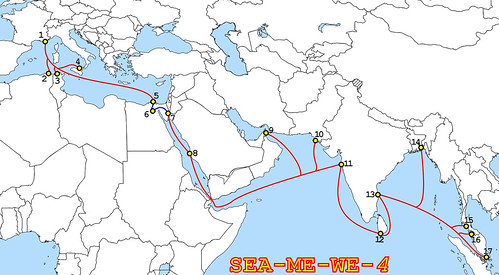
Seems the cut was somewhere between Palermo, Sicily, and Alexandria, Egypt. That sounds like the South East Asia-Middle East-West Europe 4 (SEA-ME-WE 4) cable, which has 17 landing points connected:

    1. Marseilles, France
    2. Annaba, Algeria
    3. Bizerte, Tunisia
    4. Palermo, Italy
    5. Alexandria, Egypt
    6. Cairo, Egypt (overland)
    7. Suez, Egypt (overland/return to submarine)
    8. Jeddah, Saudi Arabia
    9. Fujairah, United Arab Emirates
    10. Karachi, Pakistan
    11. Mumbai, India
    12. Colombo, Sri Lanka
    13. Chennai, India
    14. Cox's Bazar, Bangladesh
    15. Satun, Thailand
    16. Melaka/Malacca, Malaysia
    17. Tuas, Singapore

Our friends at SES NEW SKIES probably had their phones ringing off the hook yesterday. Best remedy for fiber cuts is a satcom backup. That's the "secret sauce" in a well-run network.


Score: 8.0, votes: 1

Comments

More Submarine Cable Outages in Persian Gulf

There was a third sumbarine cable cut, this time in the Pesian Gulf, near Dubai. According to Reuters, the repair ship can get out there because of the weather:

Bad weather has prevented a repair ship from setting off to mend one of three broken undersea cables providing Internet services to parts of the Middle East and Asia, an Indian-owned cable operator said.
FLAG Telecom, a wholly-owned subsidiary of India's No. 2 mobile operator Reliance Communications said on its Web site a ship loaded with spares was waiting in Abu Dhabi port to sail to a break in its FALCON cable, which was cut off the coast of Dubai on Friday.

"However due to bad weather, the port authorities have not permitted any ships to sail. As soon as weather clears, the ship will sail to the repair ground," FLAG said in its latest update, which it said was for 0600 GMT on Feb. 2.

A spokesman for Reliance Communications was unable to give a more recent update.

Undersea cable connections were initially disrupted off Egypt's northern coast on Wednesday, affecting Internet access in the Gulf region and south Asia, and forcing service providers to re-route traffic.

The initial breaches were in segments of two intercontinental cables known as SEA-ME-WE-4 and FLAG Europe-Asia.

FLAG said a repair ship loaded with spares had set sail from Catania in Italy and was expected to reach the FLAG Europe-Asia cable repair ground by Feb. 5. It said Oman Telecommunications Company had provided it with some capacity to restore services.

The third cable, FALCON, was reported cut at 0559 GMT on Friday, 56 kms (35 miles) from Dubai on a segment between the United Arab Emirates and Oman.

FLAG said that with the help of Integrated Telecom Company, it had arranged part of the restoration capacity for FALCON over land between its landing stations in Al Khobar and Jeddah in Saudi Arabia.

Some of the circuits of Qatar Telecom that were severely affected by the Falcon break had also been restored, it added.
Reliance Communication's main competitor Videsh Sanchar Nigam Ltd had said on Friday it had restored a majority of its internet connectivity into the Middle East and South Asia within 24 hours of the breakdown, using other SEA-ME-WE cables, off Egypt.

The International Cable Protection Committee, an association of 86 submarine cable operators dedicated to safeguarding submarine cables, says more than 95 percent of transoceanic telecoms and data traffic are carried by submarine cables, and the rest by satellite.

One of the biggest disruptions of modern telecoms systems was in December 2006, when a magnitude 7.1 earthquake broke nine submarine cables between Taiwan and the Philippines, cutting connections between southeast Asia and the rest of the world.
Internet links were thrown out in China, Hong Kong, Singapore, Taiwan, Japan and the Philippines, disrupting the activities of banks, airlines and all kinds of email users.

Traffic was rerouted through other cables, but it took 49 days to restore full capacity. (Reporting by Janaki Krishnan; Editing by Charlotte Cooper and Sanjeev Miglani)

But there more: a fourth cable's services were disrupted. As reported by Arabian Business, this time outside Qatar and related to power problem:

Internet services in Qatar have been seriously disrupted because of damage to an undersea telecoms cable linking the Gulf state to the UAE, the fourth such incident in less than a week.

Qatar Telecom (Qtel) said on Sunday the cable was damaged between the Qatari island of Haloul and the UAE island of Das on Friday.

The cause of damage is not yet known, but ArabianBusiness.com has been told unofficially the problem is related to the power system and not the result of a ship's anchor cutting the cable, as is thought to be the case in the other three incidents.

It is expected to take at least "a few days" to fix, according to one person with knowledge of the situation.

The damage caused major problems for internet users in Qatar over the weekend, but Qtel's loss of capacity has been kept below 40% thanks to what the telecom said was a large number of alternative routes for transmission.

It is not yet clear how badly telecom and internet services have been affected in the UAE. Etisalat is expected to release a statement on Monday.

Parts of the Gulf Arab region were plunged into a virtual internet blackout on Wednesday when two undersea cables were cut near Alexandria, on Egypt’s north coast.

The initial breaches were in segments of two intercontinental cables known as Sea-ME-We-4 and Flag Europe-Asia.

The situation was made worse on Friday when Flag, part of India's Reliance Communications, revealed a third cable, Falcon, had also been damaged off the UAE coast.

Etisalat said it does not use the Falcon cable and is therefore unaffected, but the UAE's second telco, Du, warned the damage could hamper its efforts to restore normal service to customers. Etisalat said it is helping Du minimise disruption.

This is not good for those who advocate a flat earth.

Rocco Fanucci – Mon, 2008 – 02 – 04 08:56

Submarine Cable Cut Conspiracy?

Australian Broadcasting did a piece on how these cable outages are part of a conspiracy -- or ever warfare:

When two cables in the Mediterranean were severed last week, it was put down to a mishap with a stray anchor.

Now a third cable has been cut, this time near Dubai. That, along with new evidence that ships' anchors are not to blame, has sparked theories about more sinister forces that could be at work.

For all the power of modern computing and satellites, most of the world's communications still rely on submarine cables to cross oceans.

When two cables were cut off the Egyptian port city of Alexandria last week, about a 100 million internet users were affected, mainly in India and Egypt.

The cables remain broken and internet services are still compromised.

Telecommunications analyst Paul Budde says the situation demonstrates how interconnected the world is.

"It clearly shows we are talking about a global network and a global world that we are living in," he said.

"So wherever something happens we all get, in one way or another, affected by it."

'Information warfare?'

It was assumed a ship's anchor severed the cables, but now that is in doubt and the conspiracy theories are coming out.

Egypt's Transport Ministry says video surveillance shows no ships were in the area at the time of the incident.

Online columnist Ian Brockwell says the cables may have been cut deliberately in an attempt by the US and Israel to deprive Iran of internet access.

Others back up that theory, saying the Pentagon has a secret strategy called 'information warfare'.

But Mr Budde says it is far more likely to be a coincidence.

"It is absolutely strange, of course, that that happens. At the moment it really looks like bad luck rather than anything else," he said.

Telecommunications professor at the University of Melbourne, Peter Gerrand, says Australia is in a far better position than India to withstand a cable breakage.

"We've got, in effect, five really major separate cables, each with high capacity, most of which have plans for upgrading their capacity in the next few years," he said.

Professor Gerrand does not believe Australia is vulnerable to the types of major disruptions that India and Egypt have seen.

"I gather India has most of its capacity on two cables - one's to its west and one to its east - so when the western cable got cut near Egypt, all this traffic had to then pass through a single cable and that's what's caused these very huge delays," he said.

Australia's protection zones

As it happens, Australia's protection against such incidents was boosted just last week.

Activities that could damage submarine communications cables have been prohibited off Perth's City Beach since Friday.

Australian Communications and Media Authority (ACMA) submarine cable protection manager Robyn Meikle says the events in the Middle East highlight the importance of submarine cables to all international communications.

"Here in Australia, over 99 per cent of all of our international communications carried through these cables lie at the bottom of the sea," she said.

"That's why the Australian Communications Authority [ACMA] has played a major role in declaring protection zones over our cables of national significance in Australia.

"Each of the zones, for instance, has restrictions to do with anchoring, which are aimed at preventing the sort of damage that has happened in recent times in the Middle East.

"ACMA declares protection zones over what are considered to be the main cables of national significance, and they're the ones that carry the bulk of the traffic," she said.

"So really, they are the most important cables that the industry relies on to carry all communications in and out of Australia."


Mathaba News Agency adds substantial detail to this situation:

In the 4th undersea telecommunications cable to lose connectivity within 3 days across the Middle East, Internet services in Qatar have been seriously disrupted, ensuring ongoing loss of communications across the Middle East from Egypt to India, with the exceptions of US-occupied Iraq, Isratine, Lebanon and Iran.

Qatar Telecom (Qtel) said on Sunday the cable was damaged between the Qatari island of Haloul and the UAE (United Arab Emirates) island of Das on Friday.

The cause of damage is not yet clear, but ArabianBusiness.com has been told unofficially the problem is related to the power system and not the result of a ship's anchor cutting the cable, the implausible theory touted by European and American media networks.

Physical breaks to undersea communications cables take at the very least several days and on occasion weeks to repair, due to the technical difficulties involved and requirement of specialized cable ships to reach the scene. Weather, logistics and locations affect the time required to effect a repair.

However damage can be mitigated as in the case of Qatar by finding alternative routes for transmission, where available, and Qatar has so far managed to keep internet capacity at around 60% after taking such measures.

Telecommunications and internet services have been affected in other Gulf countries, UAE's Etisalat is expected to release a statement on Monday.

Much of the Middle East and West Asia, including the Gulf Arab region, Egypt, Sri Lanka and West India were plunged into a virtual internet blackout since Wednesday when two undersea cables were cut near Alexandria, on Egypt's north coast, supplying communications to Europe and North America.

The initial breaches were in segments of two intercontinental cables known as Sea-ME-We-4 and Flag Europe-Asia, run by British company FLAG telecom.

The situation was made worse on Friday when FLAG and India's Reliance Communications, revealed that a third cable belonging to FLAG - Falcon had been damaged off the UAE coast, located 56 kilometres from Dubai on a segment between the UAE and Oman.

UAE's Etisalat telecommunications and Internet Service Provider company said it does not use the Falcon cable and is therefore unaffected. The UAE's second telco, Du, uses this cable and has warned the damage could hamper its efforts to restore normal service to customers. Etisalat said it is cooperating with Du to help minimise disruption.

FLAG said a repair ship was expected to arrive at the location of this third damaged cable within "the next few days", but that bad weather had delayed the vessel from setting off from Abu Dhabi port in the UAE.

The ship is now expected to depart on Monday morning and the repairs should take five days.

Etisalat said it had been informed by the British FLAG Telecom company, which also operates the damaged cables in the Mediterranean Sea, that the problem should be fixed in two weeks time on one of those cables, while another cable operator has plans to carry out repairs to the second cable of the Egyptian coast on February 8.

FLAG said on Saturday a ship should reach the cable repair ground by February 5.

The United States has specialist navy training and submarines precisely trained and geared to the cutting of cables and communication. International communications as well as the Internet has several bottle-necks where the break of a single cable or communications node can render countries and even regions of the world vulnerable while being heavily dependent upon a handful of companies for most of their international telecommunications.

Mustafa Alani, head of security and terrorism department at the Dubai-based Gulf Research Center, said the outage should be a "wake-up call" for governments and professionals to divert more resources to protect vital infrastructure. "This shows how easy it would be to attack" communications networks, he said.

The Israeli press has remained silent on the cuts, in spite of the news worthiness of it's Arab neighbours losing communications whilst its own remain intact, and Israeli leaders have stepped-up their unending war of words being directed at Iran. Zionist Prime Minister Olmert used the celebration of "Holocaust Day" to announce once again that Israel was ready to act against Iran on its own.

Contrary to earlier reports, Iran has not been cut off Internet nor communications and the Iranian press have not mentioned any communication problems within Iran. Iran has the highest number of Internet users in the Middle East with around 20 million Iranians online, although mostly using Persian language only, and comes in 5th place in the Middle East for percentage of population online.
 

Need another conspiracy theory? Check out this video post.

Rocco Fanucci – Fri, 2008 – 02 – 08 09:20

5.5-ton Anchor Cut the Cable

Via the AP:

An abandoned anchor was responsible for cutting one of the undersea Internet cables severed last week, causing disruptions across the Middle East and parts of Asia, the cable's owner said Friday.
 
A FLAG Telecom repair crew discovered the anchor near where the fiber-optic cable was severed Feb. 1 in the Persian Gulf, 35 miles north of Dubai, between the Emirates and Oman.

Weighing more than 5.5 tons, the anchor has been pulled to the surface. The company did not immediately explain whether the anchor moved and snapped the cable or whether the cable itself was drifting when it was sliced.

It remains unclear exactly how any of the cuts occurred.

It also was unclear whether FLAG knew what vessel the anchor belonged to. Rough weather was reported nearby at the time of the cut, but conditions have improved since.

Meanwhile, a second FLAG repair ship continued work on two undersea cables that were cut Jan. 30. They are about 5 miles off the north coast of Egypt, near the port city of Alexandria, and run between Egypt and Palermo, on the Italian island of Sicily.

Repairs at both locations are expected to be done by Sunday.

One of the two Mediterranean cables was owned by FLAG. The other, identified as SEA-ME-WE 4, or South East Asia-Middle East-West Europe 4 cable, was owned by a consortium of 16 international telecommunication companies.

Egypt's telecommunication ministry said no ships were registered near the location at the time.

The cuts slowed businesses, hampered personal Internet usage and caused a flurry of Internet blogger speculation, including mentions of sabotage. Government authorities and FLAG, which stands for Fiber-Optic Link Around the Globe, have refused to comment on the speculation.

Reports of additional cuts in Middle East Internet cables could not be confirmed.

FLAG, in a statement posted on the company Web site, said it has surveyed the cable cut off Egypt with remotely operated robots.

The FLAG spokesman said this week that it was laying a new cable underwater between Egypt and France that would be "fully resilient" against cuts such as last week's and "provide a diversity in routes."

He did not say what that resilience entailed, but said it would take months to set up the new cable.

"It is difficult to comment right now on this," said a FLAG spokesman, reached over the telephone. "We are doing our own investigation."

He spoke on condition of anonymity, in line with company policy.

Ovum analyst Matt Walker said undersea cable networks are highly vulnerable to deliberate attack and need enhanced security.

"If ports, railways, gas pipelines and other types of networks are being secured against possible sabotage, we must similarly increase the security of undersea optical highways," Walker said.

The cuts also underlined the threats that Internet disruptions could pose to organizations and businesses worldwide. Large-scale Internet disruptions are rare, but East Asia suffered nearly two months of outages and slow service after an earthquake damaged undersea cables near Taiwan in December 2006.

"The economic cost of losing, or even just slowing down, international communications is extremely high," said Walker. "This risk has to be factored into the calculations behind the investment level and design of undersea optical networks."

FLAG said it has fully restored circuits to some customers and switched others to alternative routes.

State Telecom Egypt said it sealed a $125 million contract Jan. 31 with French-American telecommunications equipment maker Alcatel-Lucent, for a new 1,900-mile-long undersea cable between Egypt and France.

Named TE North, it will link Sidi Kerir on Egypt's northern coast to the French port of Marseilles.

It will have multiple times the bandwidth capacity of existing cables and enable Telecom Egypt to "expand international connectivity, providing diversity from existing cable routes." Egyptian media have said the new Telecom cable would take more than 18 months to complete.

Rocco Fanucci – Fri, 2008 – 02 – 08 19:29

ITU: Saboteurs


From 18 February 2008, via AFP:

"We do not want to preempt the results of ongoing investigations, but we do not rule out that a deliberate act of sabotage caused the damage to the undersea cables over two weeks ago," the UN agency's head of development, Sami al-Murshed, told AFP.

Five undersea cables were damaged in late January and early February leading to disruption to Internet and telephone services in parts of the Middle East and south Asia.

There has been speculation that the sheer number of cables being cut over such a short period was too much of a coincidence and that sabotage must have been involved.

Rocco Fanucci – Fri, 2008 – 02 – 29 12:38