Satcom: The Fiber Cut Remedy

Heard about that Pacific earthquake near Taiwan while taking a break last week. Read in the New York Times how data and Internet traffic was significantly distrupted:

The quake disrupted services in Taiwan, Singapore, Hong Kong, South Korea and Japan, but a ripple effect was felt in other parts of the world. Many phone subscribers could not get through to Europe, regional telecommunications operators reported, as they raced to reroute their traffic to alternative lanes.

How prepared was everyone with mission-critical operations suddenly stopping? How vulnerable are these undersea fiber optic cables?
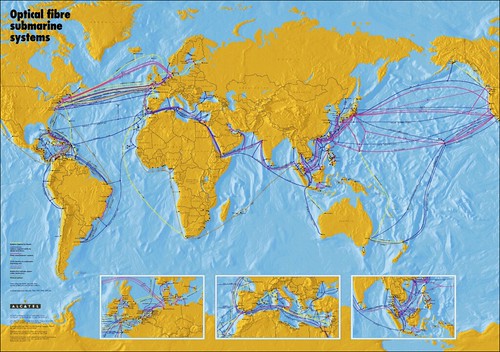
 

Was it really that bad? Seems like it was. The Korea Times reported that 6 of Korea’s 7 cables were cut, disrupting banking operations:

LG Dacom, which provides Citibank Korea’s dedicated data cables, said that the bank’s lines were cut by the 6.7-magnitude quake that struck the southern part of Taiwan.

Citibank Korea said the disruptions would not have happened if the bank had its own communication network in Korea.

"A network systems team in Taiwan oversees Citibank transactions in Korea. Severance of the submarine cable cut our connections with them, causing all the problems,’’ an official said, requesting anonymity.

HSBC Korea also relies on a foreign carrier for dedicated data lines, which are managed by its Asia-Pacific headquarters in Hong Kong.

Officials at KT and Dacom, Korea’s fixed-line operators, which jointly manage with foreign partners the cables damaged by the quakes, said other data lines were affected.

"A total of 92 dedicated data lines were severed, partially disrupting the operations of 32 of our corporate customers,’’ a KT official, Park Hae-dong, said.

KT’s clients include the Ministry of Foreign Affairs and Trade, Reuters, AT&T Korea, Posdata and SK Telink. Among financial clients are Metlife Korea, Korea Exchange Bank and Kookmin Bank.

Dacom, Citibank’s service provider, said the quake cut 26 of its lines.

Fortunately, satellites over the Pacific act as back-ups for some, while others rely exclusively on space-based redundancy for their critical communications. Several intra-Asian satellites, such as those operated by AsiaSat, came to the rescue. You can bet you sweet bippy trans-Pacific satellites such as Telstar 18, NSS-5, IS-701, AMC-23 and PAS-8 got some business from this outage.

 With communications returning to normal, we may not know the extent of the damage for another 2 weeks.  I can tell one thing we’ll know in a couple of weeks. THE hot topic at the Pacific Telecommunications Council’s annual conference in Honolulu will be the race to build another cable across the Pacific.

2 Comments

  • Rsx says:

    Its amazing how fiber wiring is done. That is some deep water.

  • Rocco Fanucci says:

    From today’s Taipei Times:

    Cable repair vessels are on the way: Chunghwa

    FIX-IT FLEET: Internet and other services disrupted by the Dec. 26 earthquakes off Taiwan’s southern coast will be brought back to normal within the next weeks

    AGENCIES, TAIPEI AND HONG KONG
    Wednesday, Jan 03, 2007, Page 11
    Chunghwa Telecom Co (中華電信) said yesterday that two repair ships will soon start fixing undersea cables damaged last week by an earthquake off Taiwan’s coast that resulted in a major disruption to telephone and Internet links across Asia.

    The two ships will take two to three weeks to complete their task, said Wu Chih-ming, a senior official at Chunghwa Telecom, the nation’s largest telecommunications firm.

    "The ships are expected to arrive in Taiwan today and tomorrow and will work at sea over the next two weeks," Wu said yesterday.

    Two more ships would join later, he said, without elaborating.

    Wu said one of the ships is Japanese-registered and sailed to Taiwan from Japan. The other, British-registered, sailed to Taiwan from the Philippines, he said. Both are specially equipped to repair undersea cables and had to complete other repair work before setting out for Taiwan.

    Chunghwa Telecom estimates the repairs will cost about NT$50 million (US$1.5 million).

    The Dec. 26 quake — measured at magnitude 6.7 by the Central Weather Bureau and 7.1 by the US Geological Survey — snapped undersea cables off Taiwan, cutting telecommunications across the region and leaving companies scrambling to reroute traffic through undamaged satellites and cables.

    Services were gradually restored in the days following the quake, but have not fully recovered.

    "We have restored all the services by re-routing," said a spokesman for KT Corp, South Korea’s largest fixed line and broadband provider.

    Voice and Internet access in Singapore was also "back to normal," said Singapore Telecommunications Ltd, Southeast Asia’s largest operator.

    "We’ve already restored the Internet service for both consumer and corporate customers," said Peter Heng, spokesman for Singapore Telecom.

    In Hong Kong, services were operating at about 70 percent to 80 percent of usual capacity, a telecommunications official said, with six of seven submarine fiber-optic cable systems linking Hong Kong to the global Internet still awaiting repairs.

    "There was no major congestion this morning. The situation is better than we thought," said Ha Yung-kuen of the Telecommunications Authority.

    Residential Internet users would still experience some delays because service providers will give business users priority, he added.

    Hong Kong’s Office of the Telecommunications Authority said plans to repair one of at least eight cables damaged in the earthquake had to be delayed by a week after a ship sent to fix the cable broke down.

    The repairs will be completed by the middle of the month, compared with an earlier estimate of Jan. 9, the agency’s assistant director, Chan Tze-yee, said at a briefing.

    "We expect we’ll see the first cable repaired by the middle of this month, and the others should be repaired by the end of the month," Chan said.

    The Hong Kong regulator’s forecasts matched the timeline by Chunghwa Telecom last week.

    In India, there were no major glitches reported, though industry officials called for better protection of undersea Internet cable routes.


Leave a Reply